

Matthew Liebenberg
Police officers based at the municipal and rural RCMP detachments in Swift Current have been working on a shared shift schedule for several months.
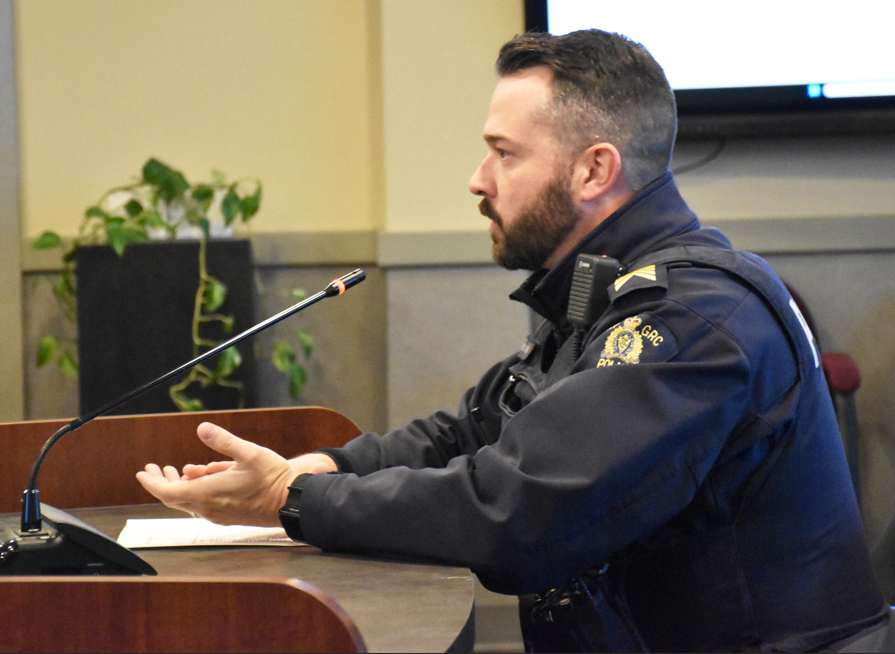
Staff Sgt. Evan Gordon, the commanding officer of the Swift Current municipal RCMP detachment, said they still remain separate detachments serving different areas.
The two detachments have been operating under a shared shift schedule for several months, starting in May 2026, to optimize officer availability and deployment.
“It basically allows us to look at the number of police officers working between Swift Current Rural and Swift Current Municipal, and if we have calls for service in one particular area it just grants both detachments access to a larger pool of resources to respond to those incidents,” he explained. “Obviously, a big part of this is ensuring that both areas are receiving proper service delivery, because they still are two separate areas.”
He noted that the use of a shared shift schedule by the two detachments should be viewed as a modernization measure similar to other initiatives taken by the RCMP such as the recent change to new navy-blue uniform shirts and updating the look of frontline police vehicles.
“This shared shift schedule is just another piece of modernization,” he said. “It’s how the RCMP are modernizing our policing approach in different communities, in different regions and areas. It’s really about strengthening our frontline staffing, enhancing investigative capacity and making sure that we’re deploying our resources effectively in order to improve public safety for communities across Saskatchewan.”
The two detachments have informally been cooperating for many years whenever a situation required additional resources and support.
“Those things have been happening for decades,” he said. “When the need arises, municipal members will attend to major events with rural members out on the highway or in rural areas, and vice versa for rural officers into the city. The difference now is that it allows us to look ahead as a management group and see areas in the future where one community or the other or both may benefit from having enhanced resources available and drawing from that larger pool of human resources for those future occasions or those times that we believe they would be valuable.”
Another benefit of the shared shift schedule is the additional flexibility available to the two detachments to deal with human resource issues.
“There’s no denying that resource pressures have been an issue for not just the RCMP, but police agencies in general across Canada and North America,” he said. “Another part of the shared shift schedule is that there may be times where your number of police officers is depleted due to training, sickness, injury, all those sorts of things. By having access to both pools of officers, it just allows us to look at those resources and manage where they are on a daily basis.”
Gordon emphasized that the reallocation of resources through the use of the shared shift schedule will not be to the detriment of service delivery in the areas being policed by the two detachments.
“A key component of this is ensuring that service delivery remains at or better than where it was prior to the use of the shared shift schedule,” he said.
He mentioned that effective communication between the two detachments is an essential element of the shared shift schedule approach.
“We are still two separate detachments with separate sets of stakeholders whom we answer to and two sets of different priorities,” he said. “The communication between the two detachments definitely has to be strong and it is. The management group contains managers and supervisors from both of those detachments. We have to be cognizant of those individual needs at both detachments when we’re utilizing the shift schedule.”
The use of the shared shift schedule by the two detachments will therefore not have any impact on the agreements for police services under which they operate.
“It really doesn’t, because the number of members assigned to each remains the same and that’s where that costing formula comes into play,” he said. “The funding is going towards those positions and making sure that those members are in the community. And really, if anything, it’s providing a benefit to both the city and to the rural in so far as when there are those times of need, they have access to that greater pool of resources that they’re not necessarily paying for one side or the other.”
The use of the shared shift schedule by the Swift Current municipal and rural RCMP detachments is not a precursor to their amalgamation.
“I’ve talked about modernization of policing and in some cases that does include amalgamating and adjusting detachment borders,” he noted. “Amalgamations do help to mitigate and address risk in areas of higher crime rates while still allowing us to be responsive to the needs of other communities that we serve as well. An amalgamation of multiple detachments though is something that would only be done after consultation with local leaders and the province and F division. I can’t say that it will never happen. It has happened in places across Saskatchewan, but currently in this particular case that shared shift schedule is seen as the effective response to our needs and issues here.”